Experience Transformation. Sustain Performance.
For decades, transformation was treated as a milestone, a program launched to solve a specific challenge or achieve a defined future state. Organizations initiated digital transformation, organizational redesign, or compliance modernization initiatives with the expectation that once completed, stability would return.
Today, that assumption no longer holds.
The pace of change facing organizations is no longer incremental; it is structural. Artificial intelligence is redefining decision-making. Governance expectations continue to evolve. Cybersecurity threats grow more sophisticated. Workforce expectations shift faster than traditional operating models can adapt.
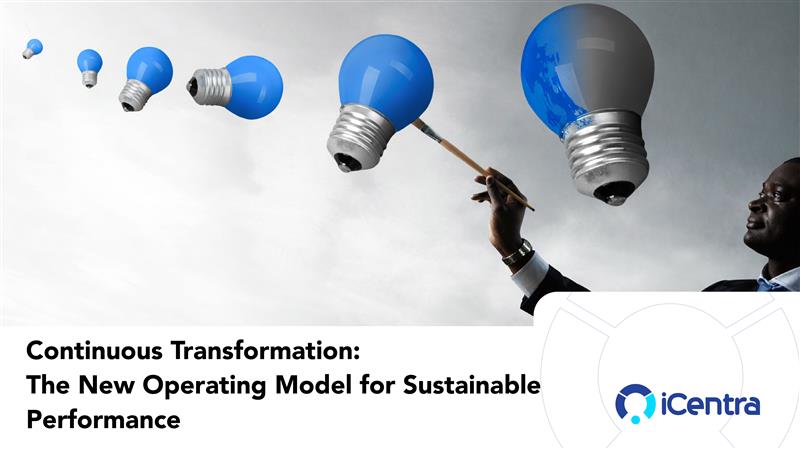
In this new reality, transformation is no longer an event. It is an operating model.
From Transformation Projects to Transformation Capability
Many organizations continue to approach transformation as isolated initiatives:
- Digital transformation programs
- Compliance or risk modernization efforts
- Organizational restructuring
- Workforce capability initiatives
While each may deliver localized improvements, fragmentation often prevents lasting impact. Strategy becomes disconnected from execution, governance slows innovation instead of enabling it, and workforce initiatives fail to embed behavioral change.
The result is transformation fatigue — repeated investments without sustained performance.
Continuous Transformation represents a fundamental shift: moving from transformation as a project to transformation as an enterprise capability.
Continuous Transformation Defined
Continuous Transformation is the ability of an organization to sustain performance through ongoing alignment of:
- Strategic direction
- Governance and resilience
- Execution discipline
- Workforce capability
- Value creation
Rather than treating change as episodic, organizations embed adaptability into their operating DNA.
The Transformation Alignment Challenge
One of the most significant barriers to sustained transformation is misalignment across the enterprise.
Organizations frequently encounter:
- portfolios that do not reflect strategic priorities
- projects that operate independently of governance structures
- workforce capability that lags behind strategic ambition
- innovation that fails to translate into measurable outcomes
Continuous Transformation requires structural alignment across these dimensions.
The iCentra Enterprise Alignment Framework — built around Portfolio, Project, People, and Product — ensures that transformation is coordinated across strategic prioritization, execution governance, organizational capability, and value realization.
Measuring Transformation Readiness
Leaders often ask:
How do we know if we are truly ready for continuous transformation?
The answer lies in assessing maturity across core transformation dimensions.
The Continuous Transformation Index™ evaluates organizations across:
- Strategic alignment
- Governance and resilience
- Execution capability
- Workforce transformation readiness
This diagnostic lens enables organizations to identify where they sit within the transformation landscape — whether operating reactively, executing effectively but without adaptability, or evolving toward continuous transformation maturity.
The Lifecycle of Continuous Transformation
Continuous Transformation is not achieved through a single intervention. It unfolds through a structured lifecycle:
- Insight — Understanding current maturity and defining reality.
- Model — Designing aligned operating structures.
- Protect — Embedding governance and resilience.
- Activate — Driving disciplined execution.
- Capability — Developing leadership and workforce readiness.
- Transform — Sustaining ongoing evolution.
This lifecycle moves organizations from reactive change toward adaptive, integrated transformation.
Leadership in the Era of Continuous Transformation
The shift toward continuous transformation demands a new leadership mindset.
Leaders must move beyond:
- static planning cycles toward adaptive strategy
- functional silos toward integrated enterprise thinking
- project-based transformation toward capability-driven evolution
Successful organizations recognize that transformation is not owned by a single department — it is a systemic enterprise function.
The Role of Continuous Transformation Partnerships
As transformation becomes continuous, organizations increasingly require partners capable of integrating multiple disciplines simultaneously.
Traditional consulting models often address strategy, technology, compliance, or learning independently. Continuous Transformation requires alignment across all dimensions.
Integrated transformation partnerships support organizations by:
- aligning strategy with execution governance
- embedding resilience into operations
- strengthening workforce capability alongside innovation
- sustaining transformation momentum over time.
The Path Forward
Continuous Transformation is not a temporary trend — it is the new operating reality.
Organizations that embrace this model will develop resilience, sustain performance, and shape their future proactively. Those that continue to treat transformation as episodic risk falling behind in an environment defined by constant evolution.
The question leaders must now ask is no longer whether transformation is necessary — but whether their organizations are structured to sustain it.
About iCentra
iCentra is a global technology and business solutions company committed to driving transformation that empowers people and organizations to achieve exceptional performance. Headquartered in Abuja, Nigeria, with offices in Texas, USA, and London, UK, we partner with clients worldwide to deliver innovative, impact-driven solutions that accelerate growth and operational excellence.
Our core service areas include Enterprise Transformation, Cybersecurity & GRC, Strategy & Execution, and Learning & Talent. At iCentra, we combine innovation, technology, and deep industry expertise to help organizations build resilience, unlock possibilities, and sustain long-term success.