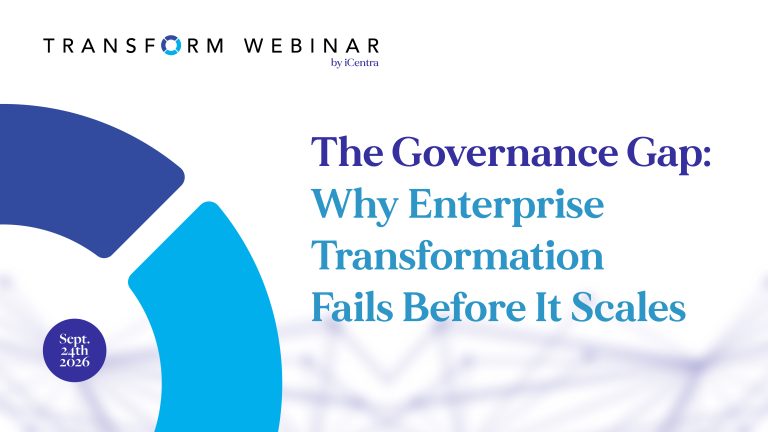
The Governance Gap: Why Enterprise Transformation Fails Before It Scales
As organizations increasingly invest in enterprise transformation, a critical challenge is emerging: successful transformation at pilot level does not always translate into sustainable enterprise-wide results.
This challenge took centre stage at iCentra’s September edition of the Transform Webinar Series, titled “The Governance Gap: Why Enterprise Transformation Fails Before It Scales.”
Held on September 24, 2026, the session examined the governance requirements for moving transformation initiatives beyond successful pilots and into sustainable enterprise capabilities. The discussion explored the importance of clear accountability, decision rights, executive sponsorship, portfolio-level governance, risk and change management, and the organizational conditions required to scale transformation effectively.
Distinguished Speakers
The high-impact session featured perspectives from:
Taopheek Babayeju — CEO, iCentra
Tao Chun Liu — Founder, PMMAYORS
Alfred Okoh — GD, Transformation & Strategy, Nigeria Revenue Service (NRS)
The conversation was moderated by Lum Ambe, Manager in the Business Core Unit at iCentra who guided the speakers through critical questions around governance, accountability, transformation ownership, scaling, decision-making, organizational capacity and enterprise execution.
Key Insights from the Speakers
Taopheek Babayeju — Ownership, Leadership & Transformation Governance
Taopheek emphasized that one of the major barriers to scaling transformation is weak ownership of the enterprise outcome.
While a pilot may succeed with a focused team and strong sponsorship, scaling introduces competing priorities, shared resources, organizational dependencies and broader risks. Without clear ownership, strong executive sponsorship and alignment across these dependencies, transformation can struggle to move from activity to sustainable enterprise value.
He further emphasized that organizations must be designed to support continuous, cross-functional transformation rather than treating transformation as a collection of isolated projects. Leadership must provide strategic direction, establish risk appetite, make resource trade-offs, secure executive sponsorship, support change management and maintain ownership of transformation benefits.
Tao Chun Liu — Ownership, AI & Readiness to Scale
Tao Chun Liu highlighted unclear end-to-end ownership as a common reason transformation pilots fail when they move toward scale.
He emphasized the importance of clearly defining the desired outcome, decision rights, expectation management, and stopping criteria. He also explored how AI can support readiness by generating potential failure scenarios, while human teams review those scenarios and rehearse how they would respond.
He further noted that scaling transformation means dealing with different functions, locations, systems, policies and user groups. Organizations therefore need to test not only whether a solution works, but also how they will manage handoffs, local variations, system outages, AI uncertainty, staff readiness, and support capacity.
Alfred Okoh — Governance, Prioritization & Enterprise Execution
Alfred Okoh examined why transformation becomes more difficult when successful initiatives move from controlled pilots into complex enterprise environments.
He highlighted competing priorities, organizational capacity, execution discipline, resistance, and change fatigue as factors that can undermine transformation at scale. He also emphasized the need to view transformation as an enterprise portfolio, rather than as disconnected initiatives owned by individual departments or business units.
Because strategic outcomes cut across technology, people, processes, data, and customer experience, individual projects can appear successful while the overall transformation remains off track. An enterprise-level portfolio view is therefore essential for maintaining alignment and visibility across transformation efforts.
What Participants Learned
The session provided practical insights into:
- Why successful transformation pilots can fail when scaled across the enterprise
- The importance of clear ownership for enterprise outcomes
- How decision rights and trade-offs should be explicitly defined
- Why transformation requires portfolio-level governance
- How executive sponsorship influences resources, adoption and benefits realization
- The importance of coordinating risk and change management as transformation scales
- Why AI rollouts require testing, human review and clear stopping criteria
- How organizations can prepare for different operating conditions across functions, locations and systems
- Why transformation should be treated as an enduring enterprise capability rather than a series of isolated projects
From Successful Pilots to Sustainable Transformation
A central message from the session was that transformation does not become easier simply because a pilot succeeds.
Moving from pilot to enterprise scale introduces new dependencies, competing priorities, shared resources, different operating conditions and broader organizational risks. Sustainable transformation therefore requires more than a working solution. It requires clear ownership, effective governance, coordinated decision-making, organizational capacity and leadership commitment.
The discussion reinforced the need for organizations to design transformation as an enterprise capability; one that can continuously navigate complexity, make informed trade-offs and deliver sustainable value.
Watch the Replay
The full Transform by iCentra: “The Governance Gap — Why Enterprise Transformation Fails Before It Scales” webinar is available to watch here:
About iCentra
iCentra is a global technology and business solutions company committed to driving transformation that empowers people and organizations to achieve exceptional performance. Through its expertise in Enterprise Transformation, Cybersecurity & GRC, Strategy & Execution, and Learning & Talent, iCentra helps organizations build resilient systems that sustain performance and deliver measurable value.