“AI is a multiplier. It multiplies whatever operating model already exists. Make sure the operating model is worth multiplying.”
— Taopheek Babayeju, CEO, iCentra
There is a version of the AI adoption story that has become very popular in executive conversations. It goes roughly like this: our execution is struggling, our teams are stretched, our processes are slow, and AI is going to change that. AI will automate the friction.
AI will fill the capacity gaps. AI will deliver the efficiency that the current operating model cannot.
This version of the story is not entirely wrong. AI can improve specific processes, automate specific tasks, and reduce specific friction points.
But it contains a critical misunderstanding about how AI works in practice one that is leading organizations into a predictable and expensive failure pattern.
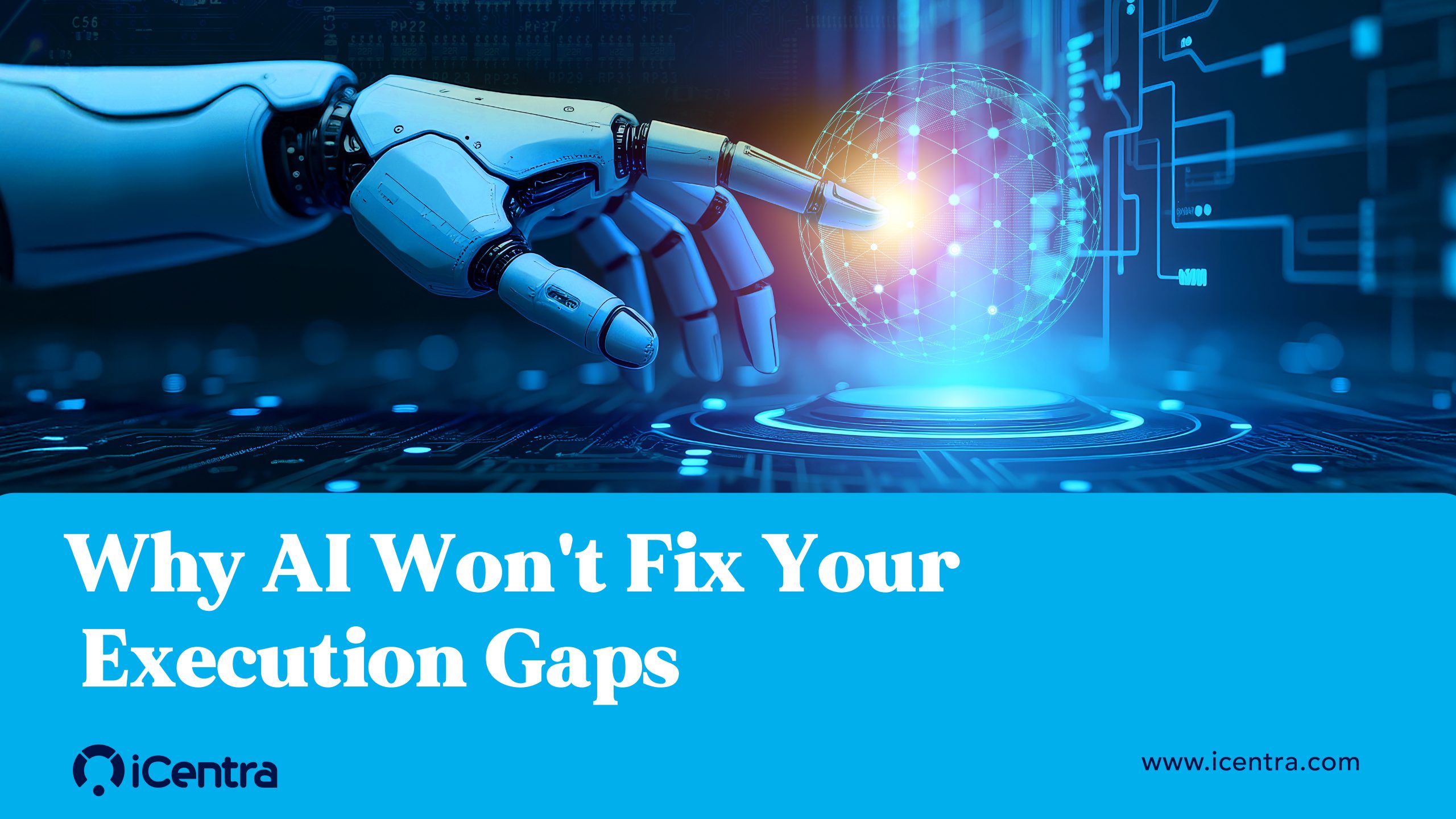
AI is a multiplier. It multiplies whatever operating model it is deployed into. If that operating model has strong governance, clear strategic priorities, and effective execution infrastructure, AI will amplify those strengths.
If the operating model has fragmented governance, unclear accountability, and weak execution disciplines, AI will amplify those weaknesses efficiently and at scale.
The organizations deploying AI into broken execution environments are not fixing their execution gaps. They are automating them.
What execution gaps actually look like
Execution gaps are rarely a mystery to the leadership teams experiencing them. They are the familiar patterns that appear across strategy cycles, portfolio reviews, and leadership assessments: strategic priorities that are clearly articulated but inconsistently delivered; initiatives that consume significant resources and produce activity without measurable outcomes; accountability structures that are nominally assigned but functionally diffuse; and decision-making that is slow, contested, or disconnected from the information needed to make it well.
These gaps are not caused by a lack of tools. They are caused by operating model weaknesses: governance architectures that do not connect strategy to execution; portfolio management disciplines that track delivery activity without tracking value realization; leadership alignment that holds at the top and fragments in the middle; and capability deficits that mean people are being asked to execute strategies they do not have the skills to deliver.
Deploying AI into this environment does not resolve these root causes. It interacts with them. An AI-powered analytics platform deployed into an organization with weak data governance produces faster access to unreliable data.
An AI-assisted project management tool deployed into an organization with unclear accountability produces better visibility of execution that no one has clear authority to course-correct. An AI content generation tool deployed into an organization with no editorial governance produces more content, faster without the quality standards or strategic alignment that would make that content valuable.
The multiplier effect in practice
The multiplier dynamic is not speculative. It is already visible in organizations that have run significant AI deployments. The pattern is consistent: AI amplifies existing organizational capability, in both directions.
Organizations with strong portfolio governance find that AI tools enhance their ability to monitor investment performance, identify risk signals early, and allocate resources with greater precision.
The tools add meaningful value because the governance architecture exists to translate that value into decisions. Organizations without portfolio governance find that AI tools generate more data about portfolio status without the decision-making infrastructure to act on it.
Organizations with mature execution disciplines find that AI automation accelerates delivery without compromising quality, because quality standards are defined and enforced by the operating model, not delegated to the tool.
Organizations with weak execution disciplines find that AI automation speeds up delivery of work that does not meet the required standard because the standard is not defined clearly enough for any system, human or AI, to reliably apply it.
This is the multiplier at work. The tool does not determine the outcome. The operating model determines the outcome. The tool amplifies it.
What needs to be in place before AI deployment
This is not an argument against AI adoption. It is an argument for sequencing. Organizations that want AI to produce sustainable returns need to ensure that the operating model into which they are deploying AI is worth multiplying. Three things must be in place.
First, governance architecture.
Before deploying AI at scale, organizations need clear answers to: who owns AI governance at the leadership level? How are AI investments evaluated and approved?
How is AI risk identified, classified, and managed? How are AI-generated decisions audited? These are governance questions, not technology questions. The answers need to exist in organizational practice, not just in policy documents.
Second, execution infrastructure.
The operating model needs functional execution infrastructure: portfolio management disciplines that connect investment to return; accountability structures that are real, not nominal; and performance management practices that track outcomes rather than activity. AI can improve the efficiency of execution infrastructure that exists. It cannot substitute for execution infrastructure that is absent.
Third, capability alignment.
The people who will govern, manage, and work alongside AI need the capabilities to do so effectively. This does not mean universal AI literacy. It means that leaders have the governance literacy to own AI outcomes, that managers have the judgment to oversee AI-assisted decisions, and that practitioners have the skills to identify when AI outputs require human override.
These are different capabilities from knowing how to use AI tools. Building them requires deliberate investment, not assumption.
The diagnostic question
The most useful question an executive team can ask before committing to a significant AI deployment is not “what can AI do for us?” It is: “what would our current operating model produce with twice the speed and three times the scale?”
If the honest answer is “better outcomes at greater speed,” AI deployment is likely to produce value. If the honest answer is “more of our current execution problems, faster and at greater scale,” the productive investment is not AI deployment. It is operating model improvement followed by AI deployment into a stronger foundation.
Many organizations find the second answer uncomfortable, because it requires acknowledging execution weaknesses that have become normalized.
But this diagnostic honesty is precisely what separates organizations that use AI to accelerate genuine competitive advantage from those that use AI to accelerate the appearance of progress.
The operating model first
iCentra’s work with organizations across sectors consistently reveals the same pattern: the organizations achieving the strongest returns from AI investment are not those that moved fastest to deploy.
They are the organizations that invested in governance, execution infrastructure, and capability before they deployed and then deployed AI into a foundation worth building on.
The sequence matters. AI deployment is not a substitute for operating model development. It is a multiplier of it.
AI is a multiplier. It multiplies whatever operating model already exists.
The strategic imperative of this moment is not simply to deploy AI. It is to ensure that when you deploy it, the operating model it multiplies is one worth the investment.
Taopheek Babayeju is the CEO of iCentra, a global technology and business solutions company helping organizations build the execution infrastructure, governance capability, and strategic alignment required to lead with AI sustainably. Learn more at icentra.com.