“Transformation is not a project. It is a permanent organizational state — and the sooner leaders build for it, the sooner the compounding begins.”— Taopheek Babayeju, CEO, iCentra
Last month’s conversation on AI governance revealed a pattern consistent with what I observe across client engagements: organizations struggling most with governance architecture are almost always the same organizations that have not yet made the deeper shift — from treating transformation as a programme to building it as an organizational capability. That is the thread connecting August’s focus on AI and GRC to September’s case for Enterprise Transformation. The two themes are not separate campaigns. They are the same argument, examined from different angles.
Most organizations I speak with describe transformation as something they did. Past tense. “We went through a transformation.” “We completed a transformation program.” “We are post-transformation.” The language itself reveals the problem. And it tells me, before any other conversation is had, that the organization has probably not transformed in any durable sense at all.
Transformation is not a phase. It is not a program. It is not a 24-month initiative with a defined end state, a ribbon-cutting moment, and a lessons-learned report filed in a shared drive that nobody opens again. These are common organizational responses to the need for transformation. They are not transformation itself. They are, at best, a managed disruption that produces temporary improvements and, at worst, an expensive exercise in activity that leaves the organization in roughly the same structural condition it started in — but now exhausted, resistant to the next change initiative, and behind the competitors who were building quietly while the program was running.
The organizations that are actually transforming — that are building genuine competitive advantages through organizational change — are doing something different. They are not running transformation programs. They are building the capacity to transform continuously. And in the current environment, that distinction is not strategic nuance. It is the difference between organizations that will compound their advantage and organizations that will fall progressively behind.
Why the Project Model Fails
The project model of transformation fails because it misunderstands what transformation is responding to. A project is an appropriate organizational response to a bounded problem — a specific technical challenge, a defined market opportunity, a singular regulatory requirement. Projects have scope, timelines, and delivery conditions. They are designed to end.
The drivers of organizational transformation are not bounded. The pace of technological change — particularly AI and digital infrastructure — is not a wave that crests and settles. It is a permanent condition of acceleration. Regulatory environments across every major market are not arriving at a stable equilibrium that organizations can build toward and then maintain. Competitive landscapes are not freezing once disruption has run its course. Workforce expectations, customer behaviors, geopolitical conditions, and supply chain realities are not resolving into a new normal that, once understood, can be addressed with a fixed response.
In this environment, the project model of transformation does not just underperform. It actively creates organizational risk. An organization that treats each wave of change as a bounded transformation program — that runs the program, declares completion, and then waits for the next disruption is in a permanent reactive posture. The program takes eighteen months. By the time it concludes, the environment has moved. The next program begins. The organization is always catching up, always spending energy on recovery rather than on building the capacity to lead.
The leaders who recognize this earliest are building something different. Not faster programs. Not more programs. A fundamentally different organizational architecture: one built for continuous transformation.
The Case for Now
The argument for Continuous Transformation™ is not new. But the urgency of acting on it now — in September 2026, in the particular conditions of the current market is higher than it has been at any point in the recent past. Here is why.
AI adoption across enterprise organizations has crossed a threshold. Three years ago, the conversation was about whether to adopt AI. Two years ago, it was about where to pilot it. Today, it is about how to govern it, how to scale it, and how to build the organizational capability to deploy it responsibly at speed. Organizations that have not built the adaptability infrastructure to absorb and integrate AI at pace are not just behind the technology curve. They are building an organizational debt that compounds with every quarter that passes.
At InnTech Summit 2025 — co-powered by iCentra in Abuja, where more than 500 senior leaders and ecosystem actors from across the globe engaged alongside 28 experts, the signal was consistent: the organizations performing best are not those with the most advanced technology. They are those with the strongest governance and alignment architecture. The technology is available to almost everyone. The organizational capacity to direct it, align it with strategy, and sustain performance improvement through it — that is the scarcer resource. And it is built deliberately, over time, or not at all.
The second driver of urgency is the competitive compounding dynamic. Continuous Transformation™ is not linear. It compounds. An organization that builds the capacity for continuous transformation in 2026 gains more than a single cycle’s advantage. It gains the structural ability to adapt faster in every subsequent cycle — to execute strategic pivots with lower disruption cost, to absorb new technology and regulatory conditions without full-scale transformation programs, to retain the talent and institutional knowledge that serial transformation programs repeatedly destroy. The competitive distance between organizations that build this capacity now and those that wait will widen with every passing year.
The third driver is leadership. The CEO’s role in transformation has changed. In the era of episodic transformation programs, the CEO was primarily a sponsor — the person who authorized the program, addressed resistance at the top, and signaled commitment to the rest of the organization. In the era of continuous transformation, the CEO is an architect. The CEO is building an organization that transforms as a permanent capability, not an organization that survives transformation as a periodic disruption. That is a different job. And most of the leaders I speak with know — even when they do not say it directly — that the shift from sponsor to architect is one they have not yet made.
What Continuous Transformation™ Actually Requires
iCentra’s Continuous Transformation™ framework is built on a precise diagnosis of why transformation programs fail and what genuinely adaptive organizations do differently.
The first requirement is strategic clarity that updates. Most transformation programs begin with a clear strategic ambition: where we need to get to. The problem is that strategic clarity is treated as a fixed input — established at the start of the program and then defended rather than updated as conditions change. Continuous transformation requires strategic clarity that is itself designed to update. Not ambiguity — the ambition must be clear and owned by leadership. But the articulation of that ambition must be connected to the environment in real time, not insulated from it behind a three-year plan that the organization treats as sacred.
The second requirement is execution infrastructure that bends without breaking. Most organizations have either rigid execution infrastructure — processes, systems, governance structures, and reporting mechanisms that are difficult and expensive to change — or loose, improvised coordination that cannot sustain performance through change. Neither works in a continuous transformation environment. What is required is infrastructure that is deliberately designed for adaptability: governance structures that can accommodate strategic pivots without full-scale redesign, systems built on modular rather than monolithic architectures, and decision-making processes that distribute authority intelligently rather than centralizing everything and creating leadership bottlenecks.
The third requirement is people capability that is developed as a strategic investment, not consumed as a resource. The talent model in most transformation programs treats people as a variable — either redeployed to execute the new strategy or removed when the new model requires different skills. Continuous transformation requires a fundamentally different relationship between organizations and their people: one where human capability is developed actively, mapped to strategic requirements, and treated as the primary source of competitive advantage that it actually is. This is not a soft statement about organizational culture. It is a hard strategic claim. The organizations that lead in the next decade will be those where the rate of human capability development matches or exceeds the rate of environmental change.
The fourth requirement is organizational alignment, the second iCentra IP at the center of September’s campaign.
The Enterprise Alignment Imperative
The most common reason transformation fails is not strategy. It is alignment. Specifically, it is the gap between the strategy leadership articulates and the daily operating reality of the organization: the decisions being made two and three levels below the executive team, the allocation of time and resources at the management layer, the incentive structures that reward the old behaviors while the new strategy demands different ones, and the information flows that are optimized for the current model and therefore systematically obscure the signals that would indicate whether the transformation is actually working.
Enterprise Alignment, as iCentra defines it, is the condition where strategy, structure, people, systems, and execution are arranged to produce the same organizational outcome. Not approximate alignment — not “broadly moving in the right direction.” The kind of precise alignment where a strategic decision made at the top produces a predictable cascade of changes in behavior, resource allocation, and performance at every level of the organization. This condition is rare. It is also the prerequisite for transformation to produce durable results.
The diagnosis iCentra brings to every client engagement on transformation begins here. Before the design of the new operating model, before the capability development program, before the technology platform decisions, the question is: what does alignment look like in this organization right now, and what would it need to look like for the transformation strategy to succeed? The answers to those questions determine the sequence, the investment priorities, and the governance architecture of the transformation — more reliably than any framework, any benchmarking exercise, or any reference to what another organization did.
What we find consistently is that the alignment gap is larger than leadership perceives. Not because leaders are uninformed, but because the standard reporting structures in most organizations are designed to surface performance, not misalignment. The dashboards show whether the numbers are moving. They do not show whether the decision-making patterns, resource allocation priorities, and behavioral norms two layers below the executive team are aligned with the strategy those executives are directing. Closing this visibility gap — building the sensing mechanisms that show where the organization is and is not aligned in real time — is itself a transformation, and often the most important one.
The Mandate Is Clear
Q4 2026 is the window in which the most forward-looking organizations will make the strategic decisions that determine their competitive position for the next three to five years. The transformation agenda, building the capacity for continuous transformation, closing the alignment gap, developing the people and execution infrastructure required to sustain performance through permanent environmental change — is not a Q4 project. But Q4 is when the decision to build it is made, or deferred for another year.
iCentra’s position is direct: the deferral is no longer available at a reasonable cost. Every quarter that passes without the Continuous Transformation™ and Enterprise Alignment architecture in place is a quarter of competitive compounding that goes to the organizations already building it. The gap narrows only one way: by starting the work.
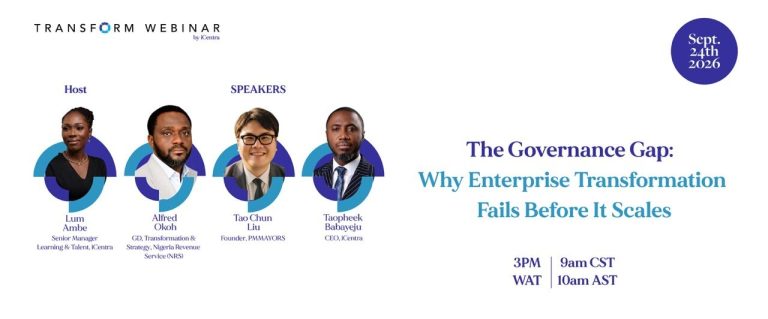
For organizations that are ready to start — or to audit where they stand — iCentra offers three entry points this September. The Enterprise Transformation Assessment maps current organizational readiness across the four dimensions of Continuous Transformation™ and produces a prioritized action plan. The September Transform Webinar — “The Governance Gap: Why Enterprise Transformation Fails Before It Scales” — examines why enterprise transformation fails at the governance layer and what organizations that successfully scale do structurally differently. And the Enterprise Transformation Practitioner Program begins in Q1 2027 for organizations ready to build this capacity internally.
Transformation is not a project. It is a permanent organizational state. The question is no longer whether to build the architecture for it. The question is whether you will build it now, while the compounding can begin, or later, when the gap has widened to the point where catching up requires far more than building would have cost.
The transformation imperative is clear. The timing is now.
Experience Transformation. Sustain Performance.
Taopheek Babayeju is the CEO of iCentra, a global enterprise transformation and business solutions company helping organizations build the governance, alignment, and capability infrastructure to compete in a permanently changing world. To learn more about iCentra’s Enterprise Transformation services, get started here.