“The organizations that govern the AI era are not the ones with the most technology. They are the ones with the clearest architecture and the strongest people.”
— Taopheek Babayeju, CEO, iCentra
Every executive conversation I have right now returns to the same two questions. The first: who, at the board level, owns AI and digital risk governance in your organization, not in a policy document, but in practice, with a framework and named accountability behind it? The second: can you trace a direct line from your talent investment this year to the specific governance capabilities your organization needs to compete?
Most leaders I speak with find both questions uncomfortable. A few are surprised by them. Almost none can answer both confidently.
That pattern is consistent across sectors, geographies, and organizations ranging from early-stage digital adopters to those well advanced in transformation, it tells me something important about the real state of enterprise governance in the AI economy.
The gap in most digital enterprises is not technology. Organizations have AI tools. They have cybersecurity investments. They have transformation roadmaps and ambitious deployment timelines. The gap is governance architecture and human capital. And the two are compounding each other as AI adoption accelerates without the frameworks or the capable people to manage it.
This is not a future problem. It is a present condition. And it is widening.
The Governance Gap
Three years ago, AI was a boardroom experiment. Today, it is a boardroom line item. Enterprise AI spending is accelerating across every sector, financial services, energy, public sector, healthcare, professional services, and the pressure to deploy AI across operations, finance, compliance, customer service, and strategy is real. The competitive motivation to move fast is legitimate.
But the speed of AI adoption has significantly outpaced the development of governance infrastructure: the accountability structures, risk frameworks, portfolio oversight mechanisms, and board-level decision authority that enable any major technology investment to be managed responsibly. Most organizations have deployed AI in multiple functions, often simultaneously. Few have built the governance architecture to manage what they have deployed.
At InnTech Summit 2025, co-powered by iCentra and strategic partners in Abuja, where more than 500 senior leaders from across Africa, the UK, and the US engaged alongside 28 global experts, this pattern emerged with consistency across every sector and geography represented. Organizations are investing in AI at a significant scale. Governance systems are lagging. The distance between what has been deployed and what is being governed is not closing. It is growing.
The consequences are not theoretical. They are accruing simultaneously across three dimensions;
- Regulatory exposure is the first. Across every major market, AI-specific regulatory requirements are advancing. The EU AI Act is reshaping compliance obligations for AI system deployers. The UK’s sector-led regulatory model is creating overlapping requirements across financial services, healthcare, and critical infrastructure. The US is moving toward sector-specific AI governance accountability that will impose obligations on organizations deploying AI at scale.
In Nigeria, the NDPR framework and sector-specific guidelines from the CBN and NCC are establishing data governance obligations that AI deployment without governance infrastructure routinely violates. Organizations that have deployed AI without the governance infrastructure to meet these obligations are accumulating regulatory exposure without fully realizing it.
- Strategic underperformance is the second. AI investments made without governance infrastructure tend to produce a consistent outcome: activity without return. Organizations deploy AI tools, generate impressive usage statistics, and discover two or three years later that the measurable strategic return is significantly below the investment made.
The reason is almost always the same. Without accountability structures, performance frameworks, and portfolio oversight, AI investments cannot be managed to return. They can only be managed to deployment. Deployment is not value.
- Organizational trust is the third. When AI-generated decisions produce harmful outcomes, misclassified customers, inaccurate financial information, biased screening decisions, exposed sensitive data, the accountability question is not technical. It is governance. Who was responsible? What was the oversight mechanism? What did the board know, and when?
Organizations without clear answers to these questions face reputational and institutional consequences that compound the direct cost of the failure itself.
The governance gap is a present condition with present consequences. It is widening every quarter that AI adoption continues without the accountability architecture to govern it.
The Talent Gap
The governance gap in technology investment has a mirror: a governance gap in human capital investment. Across the markets in which iCentra operates, the talent gap is a constant in executive conversation. What is far less common is an accurate diagnosis of what the talent gap actually is.
The standard diagnosis frames it as a supply problem. Not enough skilled people. Education not aligned to industry requirements. Competition for digital talent too intense to win at the required scale. This diagnosis is partially correct. It is not the most important part.
The most important part is this: most organizations do not govern their human capital investment with the same discipline applied to any other major strategic asset. They spend on training. They do not invest in capability. The difference is significant and structural.
Trainings spent without governance, without a strategic capability framework mapping what the organization needs, accountability for building it, and performance measurement tracking what investment produces, is activity without return. Organizations running this pattern can show impressive training completion rates, large learning catalogs, and high satisfaction scores. What they cannot show is a measurable change in the organizational capability that their strategy requires. The capability gap persists not because the investment is insufficient, but because the governance of that investment is absent.
Africa’s demographic dividend, a young, rapidly growing workforce representing a genuine competitive advantage for organizations operating on the continent is real. But it is conditional. A young workforce is an asset only when it is equipped, governed, and developed with the discipline that makes capability a sustained competitive advantage. Where that governance discipline is absent, the demographic dividend produces neither the capability the organization needs nor the strategic return the investment was intended to generate.
The talent gap, as iCentra encounters it across client engagements in Nigeria, the UK, and the US, is not a shortage of people. It is a failure of governance: the failure to treat human capability as a strategic asset requiring the same investment rigor, accountability structures, and performance measurement we apply without hesitation to technology, infrastructure, and financial capital.
Why the Two Are One Mandate
The most important insight I want to land with this article is not about either gap individually. It is about their relationship.
Governance architecture without capable people to operate it is a document. A well designed accountability structure, a mature risk framework, a board governance mechanism — each is only as effective as the leaders who operate it. An organization can have a sophisticated AI governance framework and still have no meaningful AI governance, if the people responsible for operating that framework lack the capability to do so. The architecture requires the people.
Capable people without governance architecture is activity without accountability. A talented, capable workforce operating in an organization without governance infrastructure does not automatically produce governed outcomes. Capability and accountability are related but distinct. The people require the architecture.
This interdependence is why organizations that treat the two gaps as separate agendas, governance over here, talent development over there, managed by different functions on different timelines with different accountability, consistently underperform on both. Each investment is weaker than it would be if the two were managed as one mandate. A governance architecture with no investment in the people who operate it lacks the human infrastructure to sustain it. A talent investment program without governance framework alignment produces capability that is not connected to the accountability structures that make it organizationally effective.
The organizations that will lead in the AI economy are those that close both gaps simultaneously, not sequentially, not in parallel as separate programs, but as two dimensions of a single strategic mandate. The architecture and the people, built together, with the same framework and the same accountability.
The Digital Corridor
I want to say something directly about the African context — and about the strategic opportunity it represents for organizations that get this right.
Africa cannot wait a generation for governance substrate to develop organically. The competitive window, for Nigerian financial services organizations, for energy companies operating across the continent, for public institutions responsible for digital infrastructure, for professional services firms competing for global mandates is not indefinitely open. The regulatory environments are advancing. The technology is advancing. The governance capability gap is the constraint that will determine who capitalizes on the opportunity.
The digital corridor concept captures the strategic logic of the path forward. Deliberately connecting African organizations to governance models that already work, ISO frameworks, international risk standards, global certification pathways, proven execution methodologies, and cross-market governance expertise is not dependency. It is substrate-building. The deliberate transfer of governance frameworks, sector by sector, builds the local ownership that sustains them after the transfer.
The test is not whether global standards are applied. The test is what stays: a governance architecture owned locally, a certified and capable workforce, embedded compliance discipline, and the institutional confidence to manage digital risk and talent investment as permanent organizational capabilities. A corridor that leaves nothing behind is not a corridor. It is a visit.
iCentra’s position at the intersection of global best practice and African operational context, with operations and client relationships in Nigeria, the UK, and the US, is built on exactly this model. The frameworks transfer. The capability builds locally. And the result is not compliance with external standards but governance owned from within the organization, fit for the specific regulatory environment and strategic context in which it operates.
The Intelligent Governance Framework
iCentra’s response to both gaps is a unified methodology: The Intelligent Governance Framework, Architecture and People Edition.
The Architecture Track addresses the governance gap in technology investment through four dimensions. Identify establishes portfolio visibility: every AI system, every data asset, every regulatory obligation, every accountability gap, mapped, registered, and understood before any governance action is taken. Govern builds the accountability structures and oversight mechanisms that translate visibility into active management: who owns what risk, with what authority, reporting to whom, on what schedule. Comply operationalizes regulatory obligations NDPR, GDPR, ISO 27001, AI governance frameworks as a continuous organizational practice rather than a periodic audit exercise. Recover builds the crisis leadership infrastructure: the decision protocols, communication standards, and accountability mechanisms that enable an organization to respond to a governance failure with the speed and clarity that crisis demands.
The People Track addresses the governance gap in human capital investment through four parallel dimensions. Assess maps current capability against strategic requirements at the level of specificity required to design investment that actually closes the gaps. Align prioritizes investment based on strategic criticality, accountability design, and the return calculation that connects capability development to organizational performance. Build delivers the learning architecture, from workforce-level AI fluency to executive-level governance capability, through programs designed for return, not completion. Sustain builds the continuous learning infrastructure that maintains and deepens capability as the regulatory landscape, technology environment, and organizational strategy evolve.
Four maturity levels, Reactive, Structured, Governed, Resilient, provide the shared measurement framework across both tracks, enabling organizations to assess current posture, define the investment required to move, and measure progress over time. The two tracks are not parallel programs. They are two dimensions of one framework, sharing a maturity scale, integrated accountability structures, and one organizational mandate.
The Mandate Is Clear
The market is not waiting. Regulatory environments in Nigeria, the UK, and the US are tightening around AI governance, data protection, and organizational accountability in ways that will make the governance gap more consequential with every passing quarter. AI adoption is accelerating, and the organizations without governance architecture are accumulating exposure at the same rate they are accumulating AI tools.
Simultaneously, the organizations treating talent investment as a strategic governance discipline, building capability with the same rigor applied to technology, measuring what investment produces, holding leaders accountable for development outcomes, are compounding a people advantage that becomes increasingly difficult for competitors to replicate.
The organizations that govern the AI era are not the ones with the most technology. They are the ones with the clearest architecture and the strongest people. And the decision to build both, to close both gaps simultaneously, as one mandate is not a complex one once the case is clear.
The case is clear. The architecture and the people. Both, now.
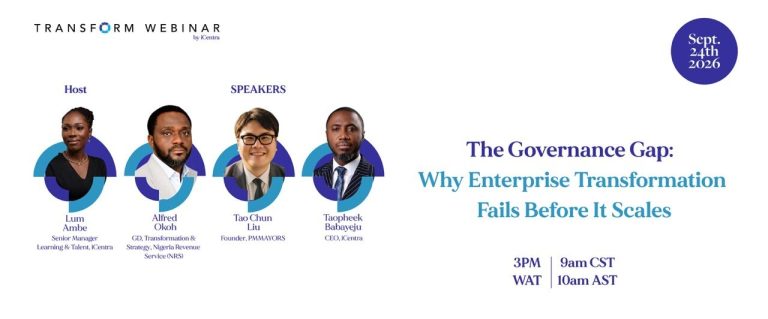
Taopheek Babayeju is the CEO of iCentra, a global technology and business solutions company helping organizations build the governance, execution, and capability infrastructure for the AI economy. To assess your organization’s current posture across both the Architecture and People tracks, access the Digital Enterprise Governance Assessment and the Intelligent Governance Framework Executive Guide at icentra.com. The August Transform Webinar — Governing the Digital Enterprise: AI, Architecture, and the People Who Make It Work — brings this conversation to the panel level. Register at icentra.com/transform-august-2026.